
How Sound-to-Print Reduces Cognitive Load for New Readers
By Eyal Rav-Noy, Co-Founder, Capit Learning
Ask a teacher why reading instruction feels so hard, and you'll often hear that teaching a child to read is like rocket science. There's a reason it feels that way—but it isn't the language, and it isn't the child. It's the sheer number of competing strategies we pile onto a beginning reader's plate. Cognitive science has a name for what goes wrong when we do that, and it points directly to why a Sound-to-Print approach works so much better.
The dozen strategies in a typical classroom
Walk into a typical early-reading classroom and count the strategies a child is expected to juggle. There are easily a dozen: rhyming, syllable clapping, onsets and rimes, phonemic awareness without letters, letter names, letter sounds, vowels and consonants, short and long vowels, word families, sight-word memorization, consonant blends, and spelling rules with their endless exceptions. Each is taught as its own thing, with its own vocabulary and its own moment to apply it.
Now imagine being five years old and meeting a word. Which tool do you reach for? Is it a sight word, or do you sound it out? Do you look for a word family or a vowel rule? The child hasn't even started decoding and already faces a paralyzing menu of choices.
The Cat in the Hat problem
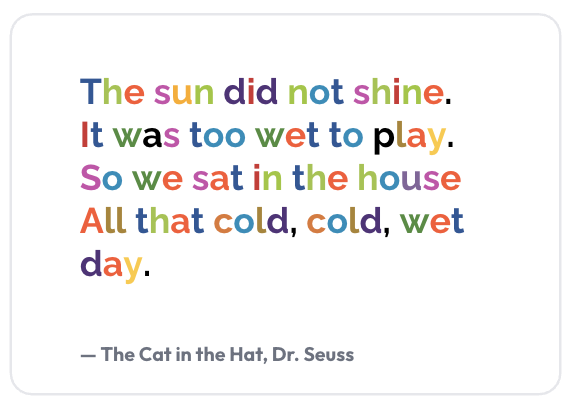
Take a single line from a book every child knows:
“The sun did not shine. It was too wet to play. So we sat in the house, all that cold, cold, wet day.”
Watch a child trained in multiple strategies try to read it. Every word becomes a decision tree before it becomes a word. The child spends their mental energy choosing a strategy instead of reading.
Should students look at individual letters?
Or should they look at the words as a whole, because some of them are Sight Words?