
Who Is Diane McGuinness?
By Eyal Rav-Noy, Co-Founder, Capit Learning
Diane McGuinness (1933–2022) was an American cognitive psychologist whose research fundamentally reshaped how reading is taught. She is best known for producing the first comprehensive analysis of the English alphabetic code from a sound base — the foundation of what is today called the Sound-to-Print method, also widely known as Speech-to-Print or Linguistic Phonics. Across more than 100 research papers and a series of influential books, she argued that most reading failure is not a disorder within the child, but the predictable result of teaching a sound-based writing system backwards: starting with letters instead of the sounds those letters represent.
A cognitive psychologist who turned to reading
McGuinness was born in 1933 in California and earned her B.A. from Occidental College in 1954. After a period teaching in the United Kingdom, she returned to formal study, earning a first-class bachelor's degree from Birkbeck College, University of London, and a PhD in cognitive psychology from University College London in 1974. She went on to a wide-ranging academic career—including research roles connected to Stanford University and a professorship at the University of South Florida, where she became Emeritus Professor of Psychology.
Though she began in cognitive psychology—publishing early work on perception and individual differences—her lasting influence came from applying the tools of cognitive science to a question most reading researchers had taken for granted: what, exactly, is the English writing system, and what does it actually demand of a learner? Her answer would challenge a century of instructional practice.
The big idea: English is a sound-based code, taught backwards
McGuinness's central insight was deceptively simple. Every writing system ever invented, she showed, is built on a unit of sound—not meaning. Alphabetic writing systems like English encode the individual sounds (phonemes) of the spoken language. English has roughly 40+ phonemes, and those sounds can be spelled in a variety of ways.
The problem, she argued, is that traditional instruction teaches this code in reverse. It starts with the letter and asks, "What sounds does this letter make?"—a question with no clean answer, because a single letter can represent many sounds (and many letters can represent a single sound). This is what makes English appear chaotic, riddled with exceptions and rules.
McGuinness's alternative flipped the direction. Start with the sounds a child already knows from speech, then teach the ways each sound can be written. In this framing, English is no longer a mess of exceptions but a learnable, reversible code: every sound has a set of spellings, and every spelling maps back to a sound. This is the essence of Sound-to-Print instruction.
Key concepts McGuinness introduced
The reversible code.
The relationship between sounds and spellings runs both ways: a sound can be written several ways, and a spelling can be read as a sound. McGuinness argued that once learners grasp this reversibility, the apparent chaos of English resolves into a system.
Basic code and advanced code.
She distinguished the basic code—the most common, reliable sound-spelling correspondences that let a learner read and write early—from the advanced code, the larger set of spelling alternatives, including many words derived from Latin and Greek. Learners master the basic code first, then expand outward.
Code overlap.
Her term for a spelling that can represent more than one sound—one of the specific features that makes English harder than more transparent languages like Finnish or Spanish.
Dyslexia is often an instructional problem.
Among her most debated claims: that much of what is labeled developmental dyslexia is not a fixed biological condition but a predictable result of a complex spelling code combined with ineffective teaching. She maintained that the large majority of children can learn to read fluently when taught the code directly and in the right order. (This view is influential but contested; see "Debates and criticism" below.)
Against early letter names.
She argued that teaching letter names early can confuse beginning readers, because a letter's name often has little to do with the sound it represents in a word. Instruction, she held, should center on sound values first.
Diane McGuinness's major books
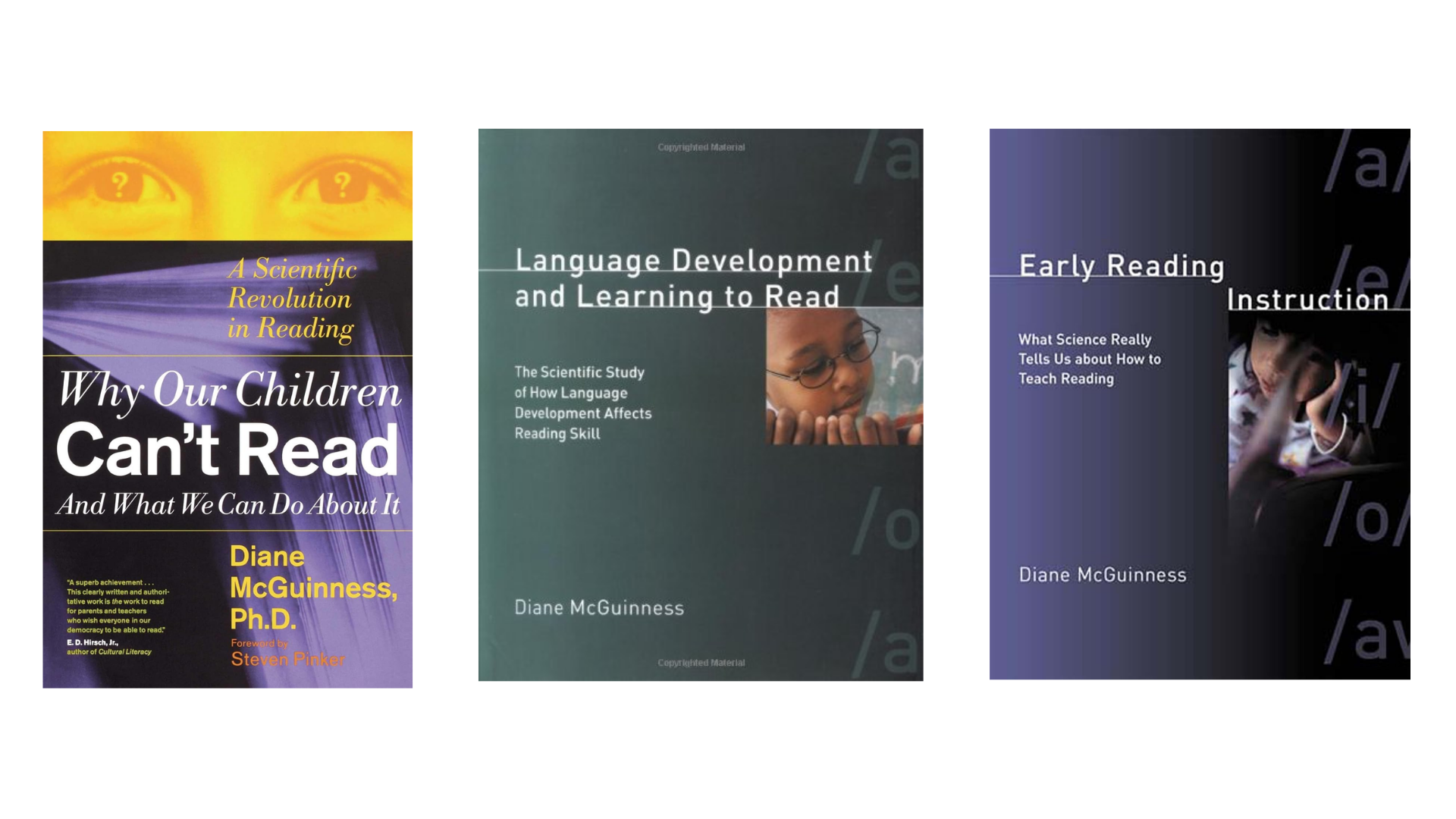
Why Our Children Can't Read and What We Can Do About It (Free Press, 1997). Her most influential book was written for a general audience. It contains a comprehensive analysis of the English writing system—its sounds and their spellings—and makes the case that reading failure stems from flawed methods, not flawed children. Steven Pinker wrote the foreword.
Early Reading Instruction: What Science Really Tells Us About How to Teach Reading (MIT Press, 2004). Her most rigorous scholarly work. Drawing on evidence from the history of writing systems through modern reading research, she develops a "prototype"—a set of elements she argues are critical to any successful reading method—and offers it as a resolution to the century-old "reading wars."
Language Development and Learning to Read (MIT Press, 2005). A deeper examination of which underlying language and cognitive skills actually predict reading success, drawing heavily on developmental psychology and the speech and hearing sciences.
When Children Don't Learn (Basic Books, 1985) and Growing a Reader from Birth (W. W. Norton, 2004) round out her work for researchers and parents, respectively. In total, she authored over 100 research papers and numerous books across her career.
Her influence on the Science of Reading
McGuinness is widely regarded as one of the intellectual architects of what is now called the Science of Reading. Her insistence on starting from the sound system of the language—rather than from letters or from whole words—anticipated and helped shape the broader movement toward explicit, evidence-based, sound-based reading instruction.
Her work seeded a family of related approaches now variously called Sound-to-Print, Speech-to-Print, Linguistic Phonics, and Structured Linguistic Literacy. Practitioners and programs influenced by her analysis—including the Phono-Graphix lineage and a generation of linguistic-phonics curricula—trace core ideas directly to her work. Her framing of English as a reversible, sound-based code remains foundational to how these methods are taught today.
Debates and criticism
McGuinness's work is influential but not uncontested, and an honest account includes the debates around it. Some researchers argue she overstated her case—that in presenting her approach as the definitive method, she underweighted genuine neurological dimensions of reading difficulty. Her strong claim that dyslexia is largely an instructional artifact is disputed by researchers who point to substantial evidence for biological and genetic contributions to reading disability. Others note that even in countries that have mandated sound-based synthetic phonics, a meaningful minority of children still struggle, suggesting that the method alone does not explain all outcomes.
What is widely accepted, even by critics, is her core descriptive contribution: her analysis of English as a sound-based code with systematic, if complex, spelling correspondences. That analysis has outlasted the controversies around her stronger claims.
For an applied perspective on why districts are moving away from Orton-Gillingham-based approaches toward Sound-to-Print, see our webinar with school and district leaders who made the switch.
How CAPIT Reading builds on McGuinness's framework
CAPIT Reading is a direct implementation of the Sound-to-Print framework McGuinness pioneered. It begins, as she argued instruction should, with the speech sounds children already produce—then teaches the ways those sounds are written, moving from the basic code to the advanced code. It treats English as the reversible code she described, and it emphasizes writing as part of decoding, consistent with her finding that writing accelerates a learner's mastery.
Where CAPIT extends her work is in delivery: a structured digital platform with built-in progress monitoring, designed to make Sound-to-Print instruction practical at the classroom and district scale, across all tiers of instruction. The method is hers; the modern implementation is CAPIT's.
Book a demo to see Sound-to-Print instruction in action.
For one example of what this looks like in practice, see how Lifeline Education Charter School reached 78% third-grade reading proficiency in a high-poverty community.
Frequently asked questions
Who was Diane McGuinness?
An American cognitive psychologist (1933–2022) who produced the first comprehensive analysis of the English alphabet code from a sound base, and a foundational figure in Sound-to-Print and Linguistic Phonics reading instruction.
What is Diane McGuinness's reading method?
A Sound-to-Print approach: begin with the sounds of spoken language, then teach the ways those sounds are spelled, treating English as a reversible sound-based code rather than a collection of letter rules and exceptions.
What is her most important book?
Why Our Children Can't Read and What We Can Do About It (1997) is her most influential general book; Early Reading Instruction (2004) is her most rigorous scholarly work.
Is Sound-to-Print the same as Speech-to-Print?
Yes—they name the same approach. "Sound-to-Print" is the term most associated with McGuinness's cognitive-science framing; "Speech-to-Print" is the term many classroom practitioners prefer because it emphasizes that instruction starts with the child's spoken language. Both name the same method, often also called Linguistic Phonics.
Did Diane McGuinness believe dyslexia isn't real?
She argued that much labeled dyslexia results from a complex spelling code plus ineffective teaching rather than a fixed biological disorder—an influential but contested position.