
The Study That Should Make Us Rethink How We Teach Sounds
We've been teaching sounds as a motor skill. The brain disagrees.
For decades, many educators have treated speech as a motor skill. If a child can’t produce a sound, they teach the mouth. “Put your tongue behind your teeth.” “Round your lips.” “Feel the air on your hand.” “Watch yourself in the mirror.” Speech pathologists build entire practices around it, and phonics programs lean on it constantly. The logic seems obvious. Speaking is something you do with your body, so learning to speak must be about training the body.
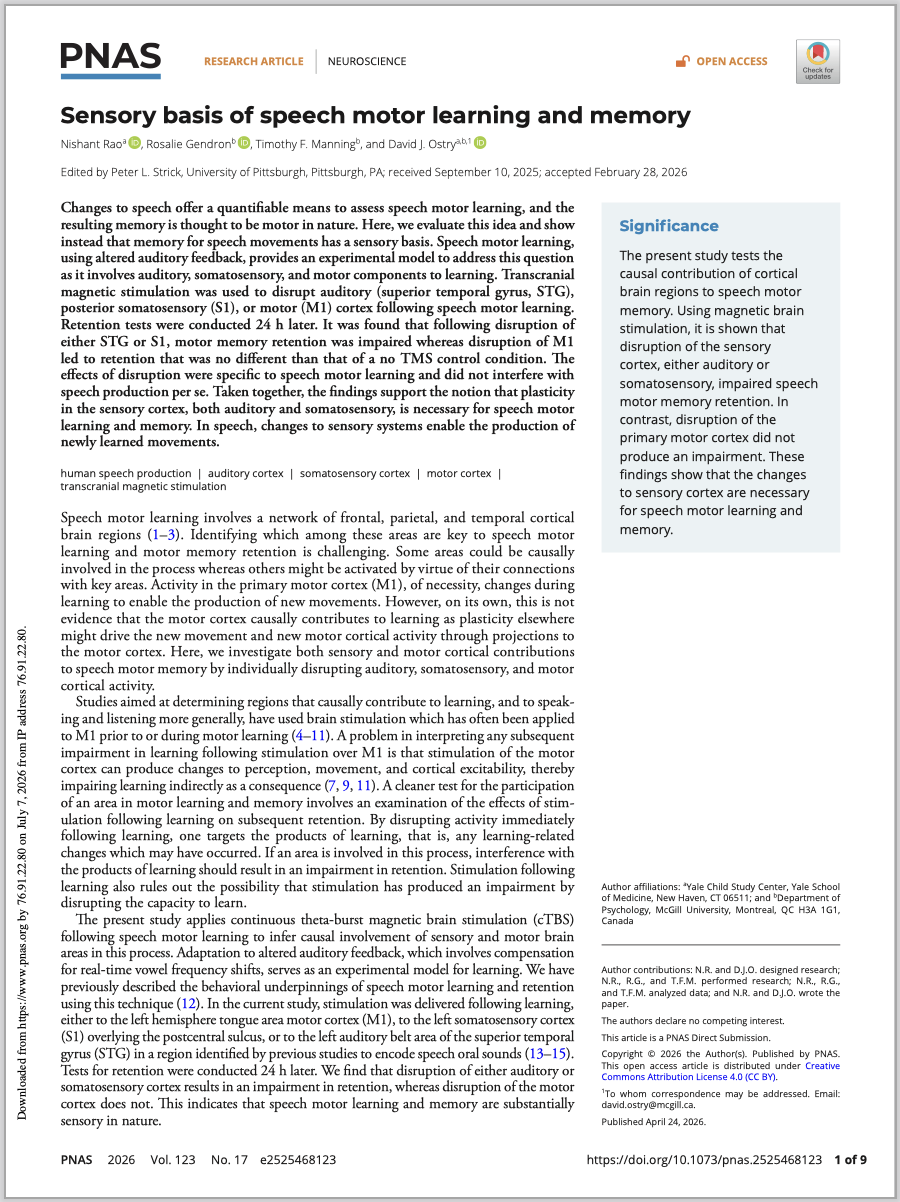
A new study in PNAS suggests the logic might be wrong.
What the researchers did
A team at Yale and McGill asked adults to read simple nonsense words out loud while wearing headphones. Through those headphones, the participants heard their own voices played back in real time—but the researchers secretly distorted the sound. A word the participant said correctly came back sounding slightly off.
People adjust automatically when this happens. Without being told to, they shift how they say the word until the version in their headphones sounds right again. That adjustment is the learning.
Once participants had learned the adjustment, the researchers used a magnetic pulse—a painless technique that briefly quiets a small area of the brain—to disrupt one of three regions. The motor cortex, which controls the movements of the mouth and tongue. The auditory cortex, which processes what you hear. Or the somatosensory cortex, which processes what you feel—in this case, the physical sensations inside your mouth as you speak.
Make it stand out
Whatever it is, the way you tell your story online can make all the difference.
A day later, they came back, and the researchers checked what had stuck.
Here’s the surprise. Disrupting the motor cortex did nothing. People remembered what they’d learned just fine. But disrupting the auditory cortex or the somatosensory cortex wiped out the memory. The parts of the brain that hear the sound and feel the sound turned out to be necessary. The part that controls the movement did not.
In other words, the brain stored the learning as something heard and felt, not as a motor command. The motor cortex was just following orders from the senses.
Why this matters for how we teach
Now think about what many do with struggling readers and speakers. They spend time and effort on the mechanics of the mouth. They diagram tongue placement. They use mirrors. They give explicit instructions on the physical act of forming a sound, as if the memory of that sound lives in the muscles.
This study suggests it doesn’t. The memory lives in the sensory systems. And those systems get what they need simply by hearing a sound clearly and producing it. The tongue diagram may not be adding much. It may just be adding time.
I want to be careful here. The study looked at adults fine-tuning sounds they already knew, not children acquiring sounds for the first time. It doesn’t prove that articulatory instruction is useless. But it shifts the burden of proof. Many have assumed motor-focused instruction works because speech is a motor skill. This research says speech memory isn’t stored where we thought it was.
If the brain learns sounds by hearing and producing them, then the fastest path is probably the simplest one. Let children hear the sound correctly. Let them say it. Let the sensory systems do what they’re built to do. The elaborate detour through mouth mechanics may be an effort we could spend elsewhere.
Sometimes, the most important thing a study tells us is to stop doing something. This might be one of those times.
The research described here is drawn from Rao, Gendron, Manning, and Ostry, Sensory basis of speech motor learning and memory (Yale University and McGill University). The interpretations and applications are my own.