
A new meta-analysis suggests that most of the hours we spend on letter-free sound drills buy us almost nothing.
If you walk into a kindergarten classroom in the morning, there is a good chance you will see children doing phonemic awareness drills. The teacher says a word, the children break it into its sounds, and then they put the sounds back together again. Nobody looks at a letter. The whole exercise happens out loud, and in many schools it happens every day for the entire year.
The reasoning behind this seems sound. Children who can hear the individual sounds in words tend to become good readers, so it makes sense to train that skill directly. If a little of it helps, more of it should help more, and the children who struggle most should get the most of all.
A new study suggests that only the first part of that reasoning holds up.
What the researchers did
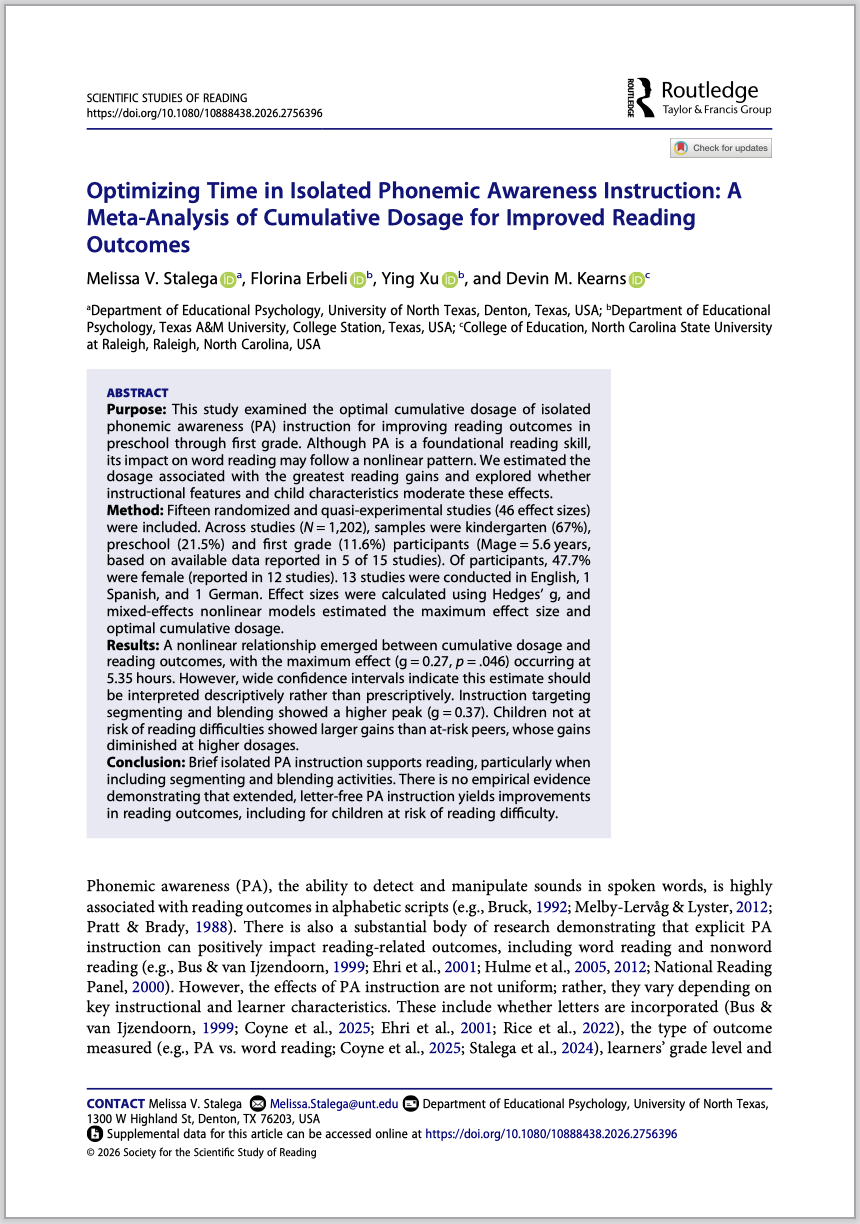
Melissa Stalega, Florina Erbeli, Ying Xu, and Devin Kearns gathered fifteen experimental studies of phonemic awareness instruction delivered without letters, in preschool through first grade. In each study, one group of children received the oral sound training and another group did not. The researchers measured how much the training improved the children’s actual reading, and then they asked whether more hours of training led to bigger gains.
That last question is the interesting one. Plenty of studies have asked whether phonemic awareness instruction works. Far fewer have asked how much of it is worth doing, which is the question a teacher with a crowded schedule actually needs answered.
What they found
The effect on reading was small. The best results came at around five hours of total instruction, but the curve was so flat that children who received just over an hour gained about as much as children who received far more. After roughly ten hours, more time added nothing at all.
The result for struggling readers is the one that deserves our attention. Many educators believe that children at risk of reading difficulties need extra oral phoneme practice, and that belief drives a great deal of intervention time. In this analysis, the extra hours did not help those children. For at-risk students, the number of hours was not related to their reading gains, and at higher doses the effect fell close to zero. The authors suggest that long stretches of oral drills may actually delay these children’s access to print, which is the very thing they need most.
The authors state their conclusion plainly. They found no empirical evidence that extended phonemic awareness instruction without letters improves reading, including for children at risk.
Why this matters
Classroom time is the scarcest resource a school has. The authors note that some popular programs devote close to thirty hours a year to isolated phonemic awareness, while programs that build sound work into phonics spend closer to four. If the benefit levels off after a few hours, then most of those thirty hours are being taken from something else. That something else is usually phonics, decoding, and spelling, which are the activities most consistently linked to reading growth.
I want to be fair to the study. The authors do not claim that oral phonemic awareness is harmful, and they still find a small benefit from brief instruction, especially when it focuses on segmenting and blending. Their estimates also carry real uncertainty, and they caution against treating any specific number of hours as a prescription. Even so, the overall picture is clear. A little letter-free sound work may help, and a lot of it does not help more.
There is a simpler path, and it has been in front of us the whole time. English writing is a code for the sounds of speech. When children segment and blend sounds while connecting each one to its spelling, they are practicing phonemic awareness and learning to read at the same time. They do not need to spend thirty hours working with sounds they can’t see before we show them what those sounds look like on the page.
Sometimes the most useful thing research can tell us is when to stop. For oral phonemic awareness, the answer appears to be much sooner than most of us were taught.
The research described here is drawn from Stalega, Erbeli, Xu, and Kearns, Optimizing Time in Isolated Phonemic Awareness Instruction: A Meta-Analysis of Cumulative Dosage for Improved Reading Outcomes (Scientific Studies of Reading, 2026). The interpretations and applications are my own.