
There is an old finding in reading research that still surprises people when they hear it. If I flash a word on a screen for a fraction of a second, you will identify its letters better than if I flash the same letters in a scrambled order. You see the “a” in “man” more easily than the “a” in “nam.” The word you recognize reaches back down and helps you see the letters it is made of. Researchers have known this since the 1800s, and it is one of the reasons we think of reading as a conversation between levels of the brain rather than a one-way assembly line.
Words do this, and sentences do it for words. So a group of researchers in Amsterdam, Paris, and Sydney asked whether morphemes do it too. A morpheme is a piece of a word that carries meaning, like the “er” in “farmer” or the “re” in “redo.” A lot of people in my field believe that the reading brain splits words into these pieces almost instantly. If that is true, a letter that sits inside a morpheme should get a little boost, the same way a letter inside a real word does.
Make it stand out
Whatever it is, the way you tell your story online can make all the difference.
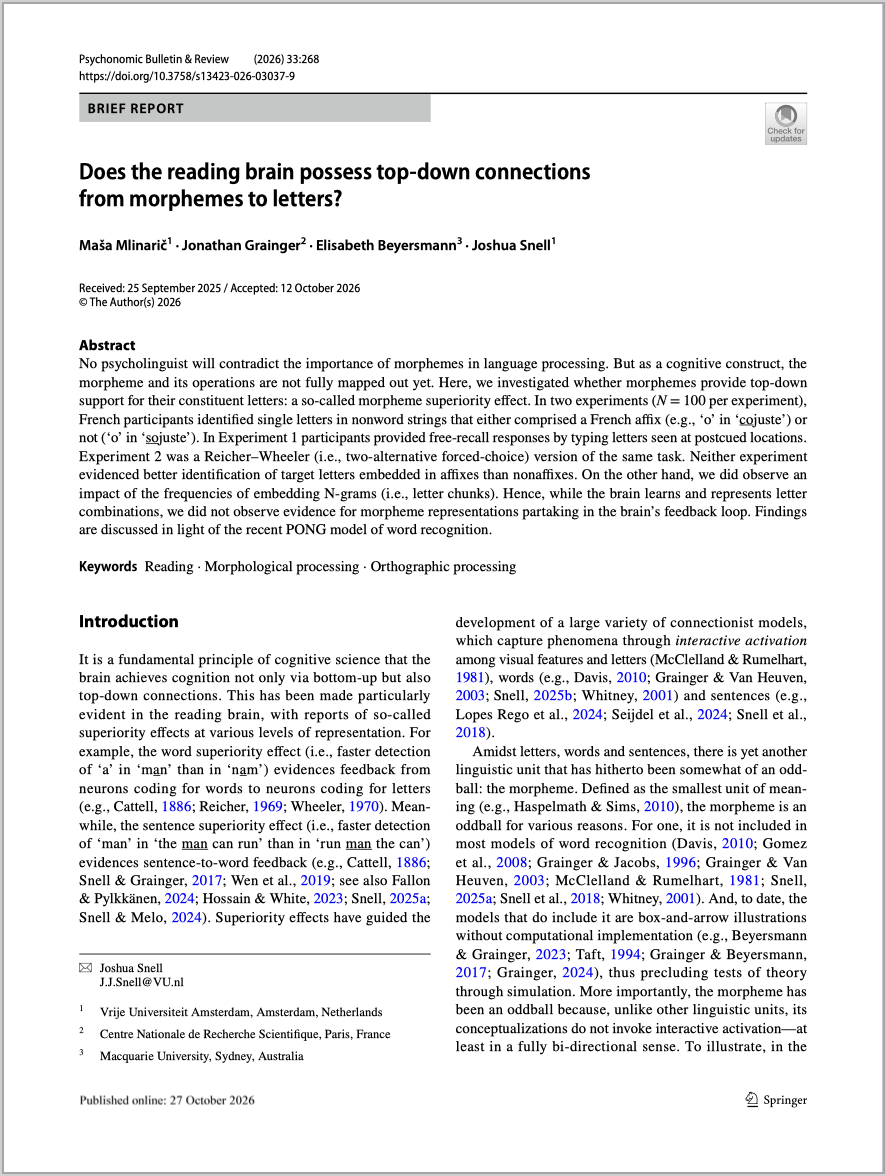
They tested this with 200 adult French readers. The readers saw made-up words for about a tenth of a second. Some of the made-up words started with a real French prefix, like “cojuste,” and some did not, like “sojuste.” Then the readers had to report a single letter, such as the second one. If morphemes help, people should do better on “cojuste” than on “sojuste.”
They did not. Across two separate experiments, people were no faster and no more accurate when the letter was part of a morpheme. The morpheme gave the letter no help at all.
Something else did make a difference, though. How often the surrounding cluster of letters appears in French print affected how well people saw the target letter. In other words, the brain clearly keeps track of letter combinations and how common they are. It just did not seem to care whether those combinations meant anything.
The authors are careful about what this means, and I want to be careful too. One study does not prove that morphemes have no place in the reading brain. They may still be there and simply not send signals back down to the letters. But the authors also point out something I have suspected for a long time. Much of the evidence for morphemes in reading can be explained just as well by how often certain letter strings appear. A morpheme may be, at least at this early stage of reading, nothing more than a group of letters you have seen many times.
This matters to me because of who we teach. Children in preschool through third grade are not taking apart words like “government.” They are learning that letters stand for sounds, and that certain letters tend to appear together in a certain order. Children learn these patterns by seeing them again and again. This study supports that idea. It found that adult readers are sensitive to how often letter combinations appear in print, which tells us the brain keeps track of the letter patterns it has seen most often.
I am not against teaching morphology. It is very useful once children can read, especially for vocabulary and spelling. But in the early grades, it should not take the place of teaching letters and sounds. Children need that foundation first, and this study is one more reminder that the brain’s early building blocks are letter patterns, not units of meaning. I did not need a study to tell me that, but I was glad to read one that did.
The paper is open access: https://doi.org/10.3758/s13423-026-03037-9
Eyal