
A study of 90,000 French first graders found that mixing memorization into phonics costs children something, and it costs struggling readers the most.
The reading wars are supposed to be over, and phonics is supposed to have won. In many classrooms, though, the victory looks more like a negotiated settlement. Children learn letter-sound patterns in the morning, memorize a list of sight words in the afternoon, and then read books full of words they haven’t been taught to decode, with a helpful picture on each page in case they get stuck.
A new study from France suggests that this compromise has a cost.
What the researchers did
Paul Gioia, Johannes Ziegler, and Jérôme Deauvieau surveyed more than 9,000 French first-grade teachers about the books and practices they used to teach reading. They then linked those answers to national reading test results for about 90,000 of the teachers’ students. Every classroom in the study taught phonics, so this was not another phonics-versus-whole-language comparison. The question was whether the way phonics is taught makes a difference.
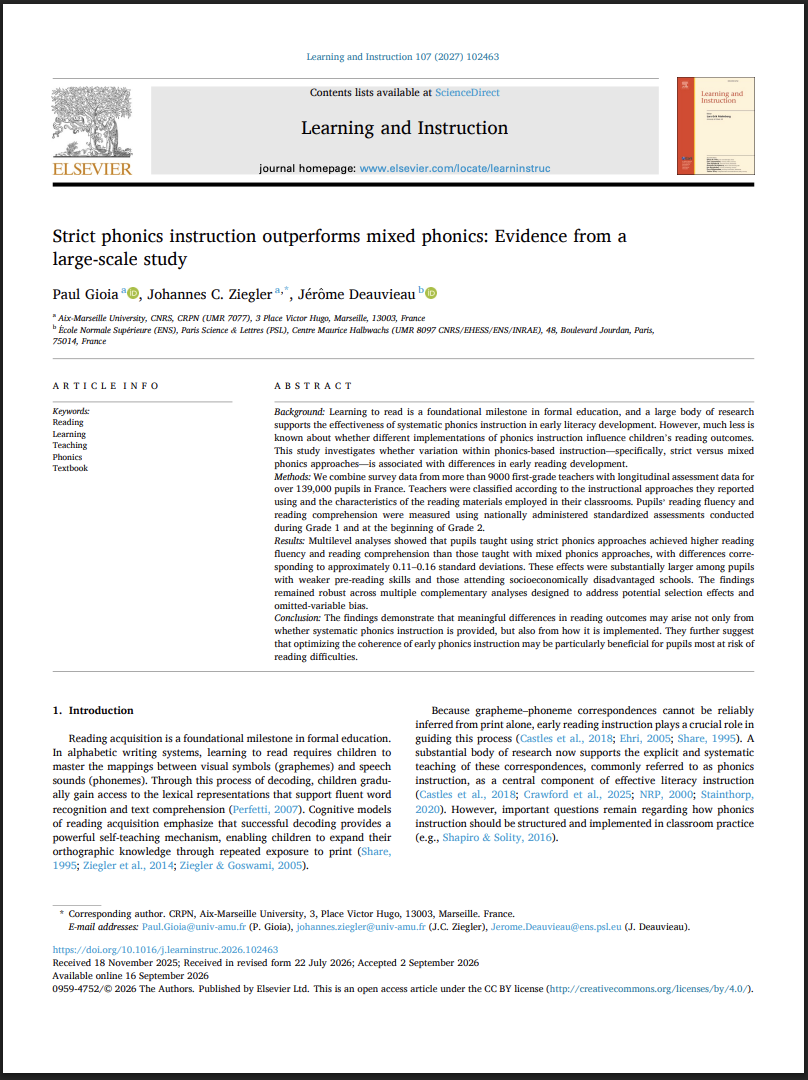
The researchers sorted classrooms into two broad groups. In strict phonics classrooms, children read only texts built from sound-spelling patterns they had already learned, and they did not memorize sight words. In mixed phonics classrooms, children also learned phonics, but they memorized words, read texts that were only partly decodable, and were encouraged to use pictures and context to figure out words.
What they found
Children taught with strict phonics read more fluently and understood more of what they read, both in the middle of first grade and at the start of second grade. The overall differences were modest, but they held up after the researchers accounted for children’s starting skills, school poverty, teacher experience, and time spent on reading.
The more important result is who benefited most. The advantage of strict phonics was much larger for children who started school with weak pre-reading skills and for children in high-poverty schools. In fact, children in disadvantaged schools taught with strict phonics read slightly faster by the middle of first grade than children in advantaged schools taught with mixed phonics. A change in teaching method was enough to close a gap that we usually blame on family income.
There is one more detail that I find almost funny. Most of the sight words French children were asked to memorize were perfectly regular words that could have been decoded once the right sound-spelling patterns were taught. The children were simply asked to memorize them before anyone had shown them how the words worked.
Why this matters
When a child meets an unfamiliar word, the child has to decide what to do with it. If decoding is the only tool the child has been given, the child decodes, and every success makes the next word easier. If the child has also been given memorization, pictures, and guessing, every new word becomes a small decision about which strategy to try. Children who get help at home can usually survive those decisions, but struggling readers pay for every wrong turn.
I want to be fair about the limits of this study. This was an observational study rather than a randomized trial, so it shows a strong pattern rather than final proof of cause, although the authors ran several checks that make the pattern hard to dismiss. It was also conducted in French, which is more consistent than English, and the authors are careful not to assume the results transfer directly. However, the principle behind the findings is not French. Children learn to read by decoding, and they learn fastest when decoding is the only thing we ask them to do.
Many people believe that English spelling makes sight words unavoidable. In my experience, most of the words we label as sight words are decodable once children know the full code. Like the French children in this study, our students are often asked to memorize words before we have taught them how those words work.
Phonics with a side of sight words feels like a sensible compromise. For the children who need us most, it is not a compromise at all, because it simply gives them less phonics.
The research described here is drawn from Gioia, Ziegler, and Deauvieau, Strict phonics instruction outperforms mixed phonics: Evidence from a large-scale study (Learning and Instruction, 2026). The interpretations and applications are my own.